Sunday, January 29, 2012

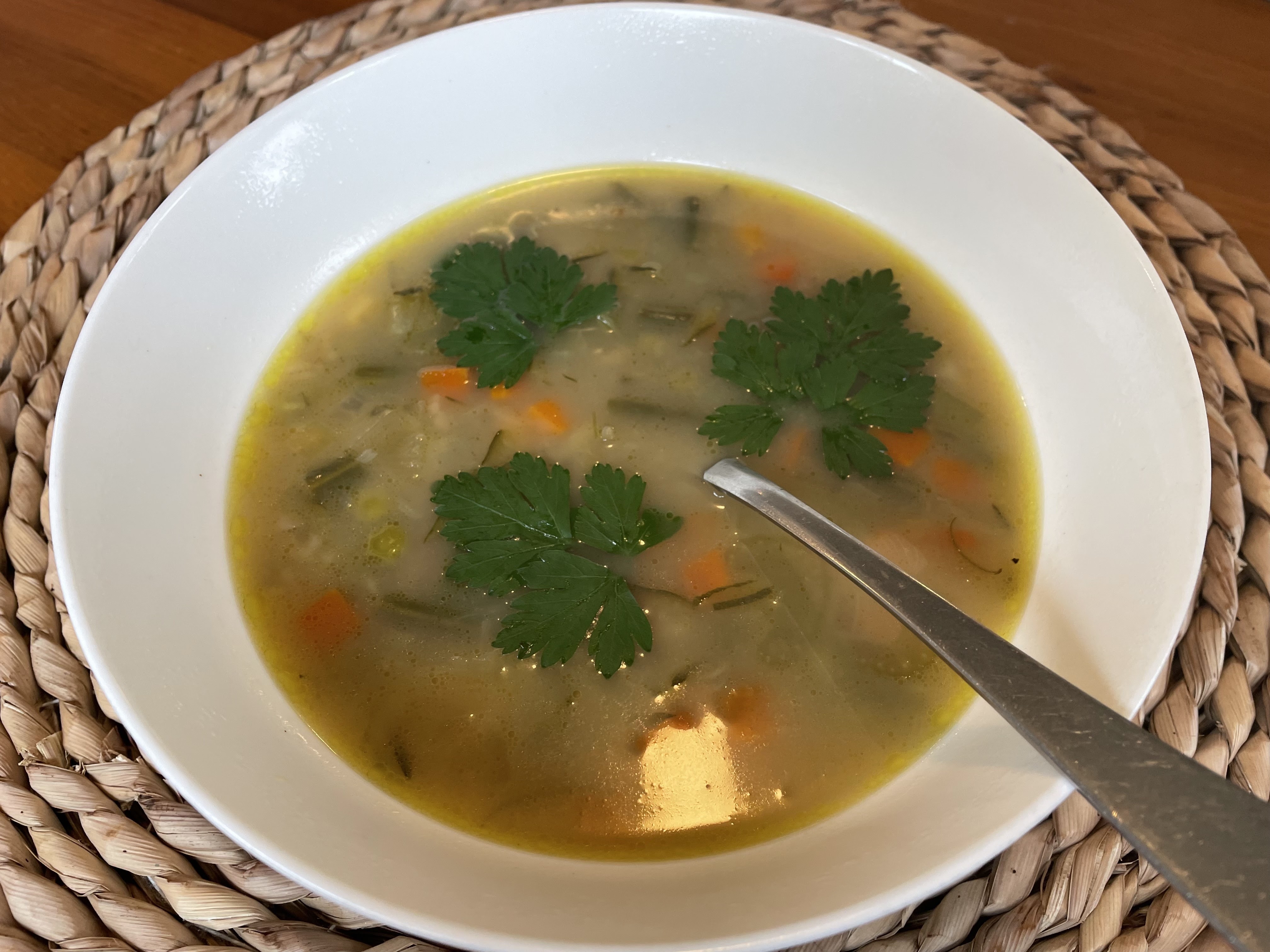
The best soup recipe ever!


OK, so I found this soup recipe on someone else's blog a few months back, and I can't for the life of me remember where I found it. I've Googled different word combinations and keep coming up blank, so I'm really sorry to the person whose recipe this is, that I can't give you due credit.

In any case, I'm in love with this recipe. I'm calling it the best soup recipe ever, because it is so easy to make, and absolutely divine to eat. In fact, I made it for my brother-in-law recently and he said it was, "The bomb". (I'm not sure if that's just a New Zealand saying, but if it is, it translates to, "Wicked awesome.") (Is that just another New Zealand saying? If it is, that translates to, "Tasty, TASTY soup, sis".)

Check it out - just three ingredients!

Ingredients


Method
1. Heat the salsa and chicken stock in a medium saucepan on a medium high heat.
2. Add the cream cheese and stir it through until it melts into the soup. You can either blend the soup to get a really smooth and creamy consistency, or you can leave it a little bit chunky. Both ways are good!

Variations
If three ingredients just doesn't seem like enough to you, feel free to add in more. Sometimes I throw in leftover shredded roast chicken, or a bit of chopped carrot or zucchini. It just means you need to cook the soup for a bit longer, to give the vegetables time to soften.

Linked to Sunday Night Soup Night on Easy Natural Food.

Friday, January 27, 2012

Cooking without Teflon - guest post by Jakob Barry

Hey friends. I'd like you to welcome Jakob Barry to Craving Fresh today. He's been following along since I posted about the doll's house I made for Lily, and he recently asked if he could guest post about Teflon, since it's more of a hazard than most people realise.


When it comes to cooking, Teflon non-stick pots and pans are something most of us love to use because of how easy it is to prepare a meal and clean up with them. However, a number of studies over the past twenty years have revealed this trouble-free process comes with a heavy price, as Teflon is actually toxic.

The main issue at hand is a host of chemicals that are released into the air when a pot made from Teflon reaches various temperatures.

For example, one of the substances that appears to be causing serious health problems is perflurooctanoic acid (PFOA), otherwise known as C8. Laboratory tests have shown that animals exposed to C8 were found to develop cancer and deformed fetuses and it is believed the same results are occurring in humans.

C8, along with other gases, is also known to instantly kill pet birds and cause a type of ‘Teflon flu’ in people that can last up to several days.

Now, if you’re like me, you’re probably thinking this is a lot to take in at once, which is very true. That being the case it’s important to put things into perspective.

On the one hand we could keep on using our Teflon pots and pans being very careful about the temperatures they reach and trying to avoid causing scratches, which some experts have said increase the dangers.

On the other hand we could replace them and use our Teflon pots for growing tomato plants this spring.

If the second option sounds more appealing and you want to steer for safety, there are a number of other cookware options that are perfectly safe to use in the kitchen. Some include the following:

1. Stainless steel
This is probably one of the safest ways to cook as pots and pans made from quality stainless steel are usually indestructible and can enhance the taste of your cooking.

Even if your stainless steel cookware is not one of the high quality versions with a thick-layered bottom that conducts heat well, it will still have the strength to last a lifetime. By adding a little oil and preheating the pot before use, you’ll get that non-stick feel without all the fumes. Your food will be healthy, your air will be pure, and your birds safe!

2. Glass
Glass is great for both stovetop and oven use. Either way it conducts heat very well and sometimes better than stainless steel. At the same time this variable makes it important to watch your pie or quiche carefully to prevent it from burning. Best of all, although glassware may require soaking to remove dry crud, it is extremely easy to clean and won’t scratch with an abrasive sponge.

3. Ceramic 
Like glass, ceramic cleans well and can withstand very high temperatures. You also don’t have to worry about scratching the pot or pan with metal utensils. Furthermore, when something is made in a ceramic vessel, it can be served right out of the oven as ceramic makes a great presenter and if you like to entertain, you know presentation can make or break a meal.

The downside is ceramic may be more expensive than other materials but from the health and décor standpoint, it is well worth the price.

4. Cast iron
Finally, cast iron is another great choice that doesn’t contain any toxic chemicals, can be heated to extremely high temperatures, is resilient and when used properly, produces the non-stick effect we all enjoy.

It should be noted that iron from this cookware often leaches into food but unless a person has an excess in their system, it’s at healthy rates and benefits those with anemia and iron deficiencies. When using cast iron it’s important to learn how to prep, clean and maintain it. Once the basics are established it’s a great outlet for all types of food preparation - both in the oven and on the stove-top


Jakob Barry is a home improvement journalist for Networx.com. He blogs about eco-friendly kitchen topics for pros across the U.S. 

Wednesday, January 25, 2012

Blender oat pancakes

This is what I ate for breakfast this morning. And it was YUMMY!

I found a recipe for blender waffles/pancakes over at Passionate Homemaking last night and used it as the base for my own recipe. I've been on the hunt for new breakfast recipes lately - ones that everyone will happily eat like Banana Coconut Pikelets.

Well, I'm happy to say that I've added another favourite to our family breakfast collection.

Lily ate a whole Blender Oat Pancake this morning, topped with a bit of real maple syrup and some blueberries. The pancake was almost as big as her plate, so that was good going.

And Paul ate two of these plate-sized pancakes in less than five minutes. When I asked how they tasted, he said, "Can't talk. Too busy eating." Yuss!

The other great thing about these pancakes is that they're so easy to make. The blender does all the work, and because you mix half the ingredients up the night before, there's not much work to do in the morning.

Ingredients
Night before
  • 2c kefir, buttermilk, whey or homemade yoghurt
  • 2T coconut oil or softened butter
  • 1/4c whole-wheat flour (this provides the phytase necessary to break down phytic acid in the rolled oats, according to this article)
  • 1 1/2c rolled oats
  • 1t vanilla extract
Morning
  • 2 eggs
  • 2t baking powder
  • 1/2t baking soda
  • 1/4t natural salt (like Himalayan Rock Salt / Celtic Sea Salt)
  • Butter for cooking

Method
1. Pour all the night before ingredients into a blender and mix on high speed for three minutes. If the mixture isn't swirling around a vortex in the blender while it mixes, add more liquid until it does.

2. Leave mixture to soak in covered blender at room temperature overnight, or for 12-24 hours.

3. When you're ready to cook the pancakes, preheat a heavy-bottomed frying pan on a medium heat.

4. Add eggs to the blender and re-blend on high speed for another minute.

5. Add baking powder, baking soda and salt to the blender and briefly mix again to incorporate.

6. Melt a little butter in the preheated frying pan and pour 1/6 of the mixture straight from the blender onto it. (Keep a spoon on hand to catch any drips from your blender.)

7. Cook first side until bubbles have made tunnels through the pancake, then flip and cook for about another minute.

Makes six pancakes. 


Serve with sliced bananas or stewed apple, real maple syrup, berries and yoghurt. 


Note: You could also try making waffles with this mixture, although I don't have a waffle maker so can't test that for you. If anyone does try making waffles, please let me know how they turn out.

Linked to the Patchwork Living Blogging Bee on Frugal Kiwi.

Tuesday, January 24, 2012

Summer garden yumminess

Welcome to my backyard.


Sophie and I are going to take you on a post-vacation tour of my vegetable gardens, so you can see just how much everything has grown since I last photographed them back in November.

Plants have journeyed out of the raised garden into the surrounding land. 
Lily loves snowpeas, but they were all pretty much done by the time we got back.
Carrots, tomatoes, basil, beans and (bug-eaten) cauliflower.
My two zucchini plants are producing well, despite the competing weeds.
Potatoes have all fallen over and need harvesting.
Beetroot and different coloured carrots I picked from the garden for juicing.
So that's how it's all looking. A bit wild and woolly, but I'm getting zucchinis, beans and carrots regularly now so it's starting to feel like my hard work is paying off.

I think my cauliflowers are all done for. They got too bug eaten while we were away. And my broccoli and cabbages don't seem to be doing much so they might be a write off too. Oh well, at least I fed some bugs this summer.

I can't wait for my tomatoes to hurry up and ripen. It will really feel like summer when we're eating those juicy little nuggets.

How are your gardens growing? Surely a lot better than mine, if you've given them any attention this summer.

Monday, January 23, 2012

Smart Sweets winner! Plus the Peppermint Bark recipe

Hey friends. Thanks everyone who entered the draw to win Smart Sweets. I've used random.org to pick a winner, and that lucky person is...

Gabriella Lacobone.

Congratulations Gabriella! I've just emailed you about this.

Save 25% on Smart Sweets this week
For everyone else who entered the draw, Katie Kimball is offering a 25% discount to Craving Fresh readers this week. Head to her online shop here and enter the discount code Fresh25 to buy your discounted copy.

Peppermint Coconut Bark recipe
I bought a huge tub of coconut oil this week, so was finally able to try the Peppermint Coconut Bark recipe I've been eyeing up in Smart Sweets. It turned out so well, I thought you would definitely want me to share the recipe. Katie said that would be OK, so here it is:

Ingredients
  • 1c unrefined coconut oil
  • 1t vanilla extract
  • 2t peppermint extract
  • 1/4c cocoa powder
  • 1/4c raw honey
  • 1c dessicated coconut

Method
1. Blend all the ingredients together in a food processor until smooth.

2. Line a baking tray with waxed baking paper.

3. Use a spatula to spread the mixture out on the baking paper as thin as you can get it - 1 to 2mm is great.

4. Freeze flat in the freezer for around 15 minutes, until solid.

5. Break into pieces and store in the fridge or freezer in an airtight container.

I love peppermint infused chocolate, and can't believe how easy it is to make this divine treat at home. 

Even though I can usually eat heaps of store-bought chocolate in one sitting, I find I only need to eat one or two pieces of this Peppermint Coconut Bark before I'm satisfied.

Honey is the sweetener in this recipe, so although it still contains fructose and can lead to weight gain, it also has many health benefits.

Lily loves this Peppermint Coconut Bark, so it's great to have a treat on hand that I feel good about giving her. Coconut oil is a great fat for the brain, and I was also told recently it helps to regulate your metabolism so I'm trying to include more of it in my diet. 

Oh wow, I just read a couple of posts about the health benefits of coconut oil, written by my friends Lydia and Lea, and it's even better for me than I realised. I'm going to try eating it heaps more from now on. 

Friday, January 20, 2012

Fresh reviews: The Great Cholesterol Con, by Dr Malcolm Kendrick


As some of you know, my father-in-law, Fox, died of a heart attack three years ago. It wasn't his first major heart attack. He'd already had one eleven years previously (aged 48), and was saved by major heart surgery.

Without that surgical intervention, I would never have met my husband's wonderful Dad. As it is, my girls won't get the chance to meet their Grandad this side of heaven.

Fox's own father also died of a heart attack, in his early 70s. Given this family history of heart disease, you can understand why I'm more than a little concerned for my husband and children.

When Paul and I were first married, I followed the same advice most people do to try and prevent heart disease, ie. reduce saturated fat and cholesterol intake. I wasn't really worried for myself, but I distinctly remember arguing with Paul in the supermarket because he wanted to buy full-fat cream cheese and milk, and I wanted him to buy reduced fat versions because of his family history of heart disease.

You can imagine his relief and mine, when I learned cholesterol and saturated fats are not only good for you, but essential for health and life.

However, it is so engrained in people's mindsets that cholesterol is bad for us, I felt I needed to do more research in order to understand why cholesterol is our friend, not our enemy.

Enter stage left: The Great Cholesterol Con, by Dr Malcolm Kendrick.

I got this book out of the library at the same time I got out Sweet Poison. Because I read Sweet Poison first, it took me a while to get around to The Great Cholesterol Con. I actually considered returning it without reading it as I figured I probably already knew most of what it was going to say.

Boy I'm glad I decided to open that first page. It had me at, "hello".

I devoured the book in a couple of nights and was going to do a post on it for you immediately, but got too sick to even sit up. Unfortunately, that means I don't have the book in front of me now as I write this, since I had to return it to the library.

I'll do my best to capture its essence.

The Great Cholesterol Con was a fantastic first full book to read on the subject of cholesterol as it translates medical jargon and research with clarity and humour. Kendrick's snappy comebacks to mainstream dogma reminded me of interchanges between Lorelai and anybody else on the Gilmore Girls.

I learned so much about how the human body works, and what is going on when a stroke or heart attack occurs.

Why do people think saturated fat and cholesterol cause heart disease?
In the 1950s, a man named Ancel Keys wrote a very flawed paper entitled: Atherosclerosis: a problem in new public health. Journal of Mount Sinai Hospital, 1953; 20:118-139

In it, Keys hand-picked data from six countries that showed a clear link between heart disease and the dietary intake of fat.

He actually had data from 22 countries available to him, but left out the rest as they told a completely different story. He was a man on a mission to prove that dietary intake of saturated fat causes heart disease, and he wasn't going to let mere facts get in his way.

Unfortunately, Keys was an influential advisor to the American Heart Association because of some previously excellent scientific work he had done. This meant his flawed "Lipid Hypothesis" was widely publicised and used as the basis for US dietary guidelines from then on.

You can read more about controversy surrounding the Lipid Hypothesis here.

In The Great Cholesterol Con, Kendrick cites study after study disproving the Lipid Hypothesis. For example, in Japan incidents of stroke and heart disease both decreased when total serum cholesterol increased. That's because the human brain is almost entirely made of cholesterol, so people in Japan on very low fat/cholesterol diets were stroking out early.

When the population purposefully increased its dietary intake of saturated fat and cholesterol, stroke rates plummeted. Surprisingly, so did rates of heart disease. That is because cholesterol also gives veins and arteries their integrity, and it helps repair damage.

Ancel Keys noticed cholesterol was always found on the scene of heart attacks, and he became convinced it was the cause.

The truth is, cholesterol doesn't cause heart disease, it's helps to heal it.

Before returning The Great Cholesterol Con to the library, I managed to copy down one quote for you:

"I sometimes remark to those who think my ideas on heart disease are entirely batty, 'Why do you think that an egg yolk is full of cholesterol? Answer: because it takes one hell of a lot of cholesterol to build a healthy chicken. It also takes a hell of a lot of cholesterol to build, and maintain, a healthy human being. In fact, cholesterol is so vital that all cells, apart from neurones, can manufacture cholesterol, and one of the key functions of the liver is to synthesize cholesterol. We also have an entire transportation system dedicated to moving cholesterol around the body." p.12.

If cholesterol is good, why are we always told to lower it?
As with most areas of health today, money is a bigger motivator than actual good health. As Kendrick points out, cholesterol-lowering statins are the number one selling drug of ALL time.

And statins have been proven to help men with pre-existing heart disease.

They have NOT, however, been proven to help any women, ever. In fact, total morbitity increases in women taking statins, because of all their nasty side effects. Statins also DO NOT help men without pre-existing heart disease.

The cholesterol-lowering aspect of statins likely does more harm than good. Kendrick points to many studies that show people with heart disease whose cholesterol levels are high have a better chance of surviving than people who have naturally lower cholesterol levels, or who purposefully try to reduce their levels.

Kendrick argues that the reason statins work at all in men with pre-existing heart disease is because they are blood thinners - much like aspirin. Since most heart attacks occur when clots burst, thinning those clots can help reduce a person's chance of dying of a heart attack.

However, pharmaceutical companies prefer people to think statins work by lowering cholesterol because then they capture a bigger market - women, men without heart disease, anyone with a total serum cholesterol level over whatever pharmaceutical companies can convince us is "safe". (A level they're constantly arguing downwards so that they can sell ever more statins.)

But we talk to doctors, not pharmaceutical companies? Kendrick writes about the influence that pharmaceutical companies have over the medical profession. It is insidious, and worse than I would have believed possible.

If cholesterol isn't to blame, what is?
Kendrick does a neat job of building suspense in The Great Cholesterol Con, as he dismantles current arguments for why cholesterol causes heart disease, without letting on too early what he views to be the main cause - stress.

He makes a convincing argument for why stress causes heart disease. Social displacement, he argues, is one of the biggest stressors known to man and Kendrick gives numerous examples of socially displaced peoples with elevated rates of heart disease.

I think he's onto something with his argument, However, other reading I've done has convinced me that the Western diet also has a lot to answer for when it comes to all aspects of health. We eat too much processed food, refined sugar and trans-fatty acids, and this also causes our bodies to run amuck.

Where to now?
One thing that I felt was never fully resolved in The Great Cholesterol Con is the issue of familial atherosclerosis, which is the genetic mutation I think my husband's family suffers from. I would really like to get to the bottom of that one, to learn what I can do to help my family. I guess I'll have to keep researching and reading.

Apparently there's another book of the same title, The Great Cholesterol Con, by another author. Perhaps I'll read that one next and compare notes.

What's your take on the cholesterol debate?


Linked to the Patchwork Living Blogging Bee.

Tuesday, January 17, 2012

When should I start my baby on solids?

[Remember to enter the draw to win a copy of Smart Sweets if you haven't already.]

Sophie is seven months old already. Can you believe it? I can't quite.

I was going to write a post about introducing solids last month, when Sophie turned six months, but she wasn't ready for solids then so I've waited until now when she's eating them a little more regularly.

When I first tried introducing food to Sophie, she seemed to react to everything right away (it gave her an upset tummy). She also really didn't like eating. She quickly worked out that if she just left her mouth open, the food would fall back out and she wouldn't have to swallow it.
Sophie feeding herself roast kumara.
For those reasons and because Sophie couldn't yet sit up by herself yet, I decided to give her a break for a couple of weeks.

After that I started to test her with solids every few days, but it wasn't until she was seven months old that she seemed interested in eating a couple of bites and able to keep it down. Other problems she'd been having with reflux also showed improvement around the seven month mark, which has been a huge relief.
Happy eating girl.
My tips for starting a baby on solids
(Note: I'm not a dietitian, these are just the tips that have worked for me.)
  • When your baby is about six months old, start watching them for signs of readiness. Are they able to sit up unsupported? Have they lost their tongue-thrust reflex? Do they show an interest in food? If the answer to all the questions above is yes, your baby could be ready to start eating solid food. 
  • Until baby is at least nine months old, always offer breast milk / formula first.
  • Don't go overboard on the solids to start out with - a taste here and there will suffice. The initial stage is about introducing baby to new tastes and the texture of food. It's not to fill their tummy - that's still the job of breast milk / formula until baby is about one.  Modern Alternative Mama has written a wonderful post about introducing solids. In it she says that "enzyme production (like amylase) doesn't even really start until 8 - 9 months of age, so there's no reason to begin solids much earlier than this, even with babies that seem interested and especially with babies prone to allergies."
  • Try one new food a week and watch for any signs of intolerance or allergic reaction (read more about these signs below). If your baby shows a reaction, hold off on that food for another couple of months and test again. By then their digestive system will be more developed and better able to handle that food, if it's not a true allergy.
  • Feed baby new foods in the morning so that if they do have a reaction, you've got the day to deal with it and don't have to try settling an upset baby overnight.
  • Experiment with both pureed foods (like mashed banana, mashed cooked pumpkin, boiled egg yolk, steamed and pureed pear/apple) and soft but solid food that your baby can hold to feed themselves (like avocado wedges, boiled or roast kumara wedges, roast chicken or beef chunks). I have more success with foods that Sophie can hold, and it's actually less work too. You could try cooking veges in chicken stock instead of water to give them an even greater nutritional boost.
  • Every now and then add a splash of butter and a tiny sprinkle of real salt (like Celtic Sea Salt, Himalayan Rock Salt) to your baby's food. This is a winning combo that contains lots of fats, vitamins and minerals your baby needs to develop and be healthy.
  • Avoid all grains until your baby is at least nine months old (including sweet corn and boxed rice cereal) as these are difficult for babies to digest.
Common symptoms of allergic reactions (from  Well Adjusted Babies , by Dr Jennifer Barham-Floreani)
  • Flushing
  • Rashes
  • Itching
  • Vomiting
  • Swelling of lips, tongue, throat
  • Difficulty breathing, asthma
  • The allergic face:
    • Runny congested nose
    • Dark rings under eyes
    • Red ears
    • Eczema
Common symptoms of food intolerance (also from  Well Adjusted Babies , by Dr Jennifer Barham-Floreani)
  • Congestion with coughing, sniffing and runny nose
  • Eczema
  • Rash around the mouth
  • Severe nappy rash
  • Asthma
  • Glue Ear
  • Headaches or Migraines
  • Aching muscles and joints
  • Infantile insomnia
  • Poor appetite
  • Vomiting
  • Stomach aches, colic (in babies)
  • Persistent diarrhoea
  • Behavioural disorders, including hyperactivity

What are your tips for introducing babies to solids? I'd love to hear from you.


Linked to Monday Mania at The Healthy Home Economist and The Patchwork Living Blogging Bee at Frugal Kiwi.